contact: [email protected] or 08 8345 3180

I was born in Adelaide, but raised in country South Australia. I went to Teacher’s College and Art School, taught school, and then college. In the mid 1970’s I became a free-lance artist, writer and workshop tutor: stitch the favoured medium. In the mid 80’s a return to University, resulted in an MA in Visual Arts, from Flinders University South Australia.
At heart I am an embroiderer, working by hand,machine, and digital stitch. From the early 90's digital technology has made available a whole new palette, expanding all the time. However wonderful the technology, the driving force in the work is always the subject.
Early on I decided that it was better to work on more than one thing at a time: the aim was to always have a back-up in case of some catastrophic error. This has led to works in series, which usually develop over several years. The early works ‘Babbage Collection’ dealt with the birth of the computer age, and the ‘Antikythera Instrument’ collection with its precursor in Hellenistic times. The ‘Fragile Zone’ dealt with desert environments, and its source is the northern desert around Lake Eyre and Yorkeys Crossing just out of Port Augusta. This did expand into the “Arid Zone’ collection: Wrecked cars are scattered about the dusty land, monuments to failed endeavor in the face of a parched,relentless environment.
The urban beach near my home has also been important, and ‘The Littoral Zone’ collection in lace resulted, along with a large collection of Beach Dresses named ‘The Tennyson Collection’ after our local beach. I tend to return to the Beach theme often, and try to walk there daily.
By 2002-4 the poet John Shaw Neilson provided inspiration for a major collection, shown in Adelaide, Perth, Penola and Mudgee,and to TATA gallery in Brisbane.
However, this last decade or so the desert again holds a fascination, with it fragile, subtle detail, vast horizons, and geological age that beggars imagination. The ragged mountains, mere remnants of ancient Himalayan-scale landscapes hold ancient secrets. Fossils lie under old seabeds, the beaches now high in the landscape. Fossils are but rarely visible and then only in a glancing light. The slow moving processes of climate and time seem to be but briefly interrupted by our human presence. Recent work is below and more in the Gallery. Enjoy!
At heart I am an embroiderer, working by hand,machine, and digital stitch. From the early 90's digital technology has made available a whole new palette, expanding all the time. However wonderful the technology, the driving force in the work is always the subject.
Early on I decided that it was better to work on more than one thing at a time: the aim was to always have a back-up in case of some catastrophic error. This has led to works in series, which usually develop over several years. The early works ‘Babbage Collection’ dealt with the birth of the computer age, and the ‘Antikythera Instrument’ collection with its precursor in Hellenistic times. The ‘Fragile Zone’ dealt with desert environments, and its source is the northern desert around Lake Eyre and Yorkeys Crossing just out of Port Augusta. This did expand into the “Arid Zone’ collection: Wrecked cars are scattered about the dusty land, monuments to failed endeavor in the face of a parched,relentless environment.
The urban beach near my home has also been important, and ‘The Littoral Zone’ collection in lace resulted, along with a large collection of Beach Dresses named ‘The Tennyson Collection’ after our local beach. I tend to return to the Beach theme often, and try to walk there daily.
By 2002-4 the poet John Shaw Neilson provided inspiration for a major collection, shown in Adelaide, Perth, Penola and Mudgee,and to TATA gallery in Brisbane.
However, this last decade or so the desert again holds a fascination, with it fragile, subtle detail, vast horizons, and geological age that beggars imagination. The ragged mountains, mere remnants of ancient Himalayan-scale landscapes hold ancient secrets. Fossils lie under old seabeds, the beaches now high in the landscape. Fossils are but rarely visible and then only in a glancing light. The slow moving processes of climate and time seem to be but briefly interrupted by our human presence. Recent work is below and more in the Gallery. Enjoy!
The Reef Suite 2016 - 2018
Several recent trips to the northern regions of the Great Barrier Reef resulted in a huge number of photographs and a pile of scribbled rough sketches.
Slowly the Reef Suite is taking shape, (a dozen works so far) both as non-traditional quilted textiles and in lace. The final drive to create came with the arrival of the iconic publication from 1893 of William Saville-Kent's (1845 - 1908) celebrated tome, which a quick-witted friend acquired for me in Townsville. Enjoy.
Slowly the Reef Suite is taking shape, (a dozen works so far) both as non-traditional quilted textiles and in lace. The final drive to create came with the arrival of the iconic publication from 1893 of William Saville-Kent's (1845 - 1908) celebrated tome, which a quick-witted friend acquired for me in Townsville. Enjoy.
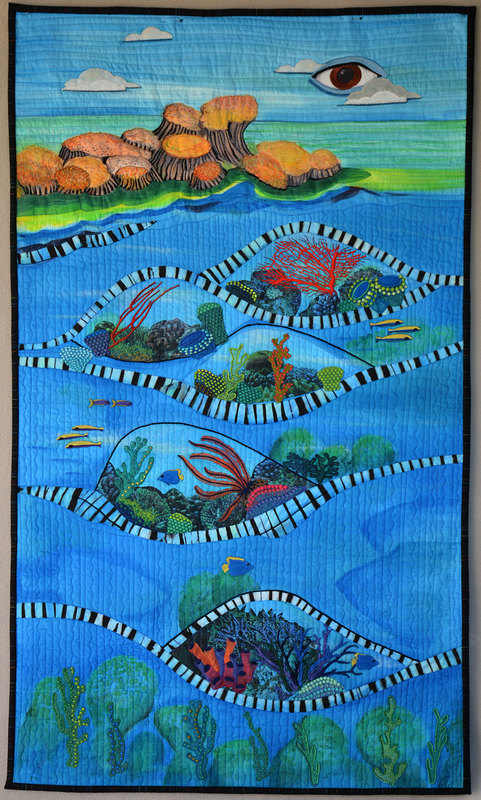
The REEF: An Eye on the Reef - Low-tide 70 x 122cms
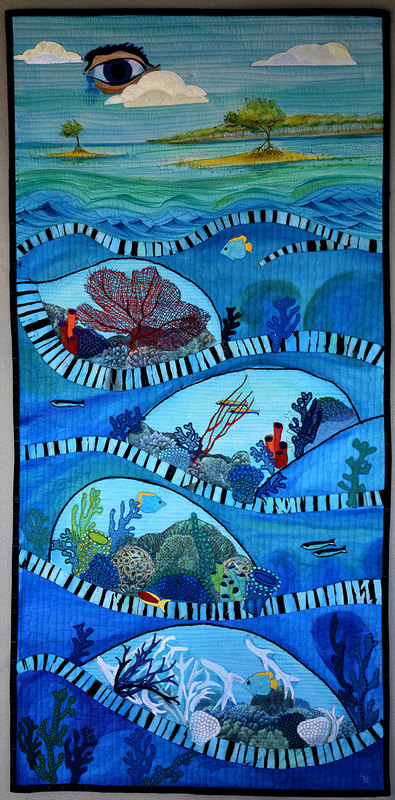
The REEF: WSK Eye on the Reef: Mangroves 55 x 118 cms
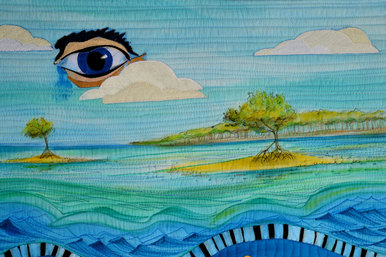
Details of mangroves
|
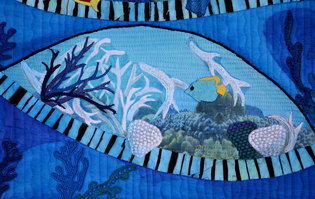
Details of bleaching
|
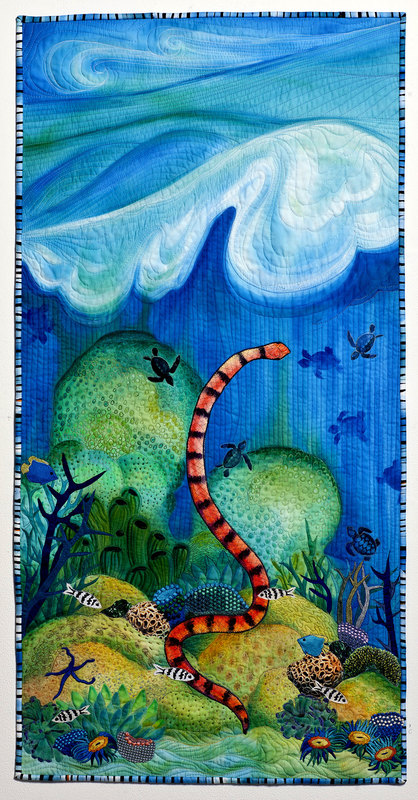
The Reef: Sea-serpent 60 x 120 cms
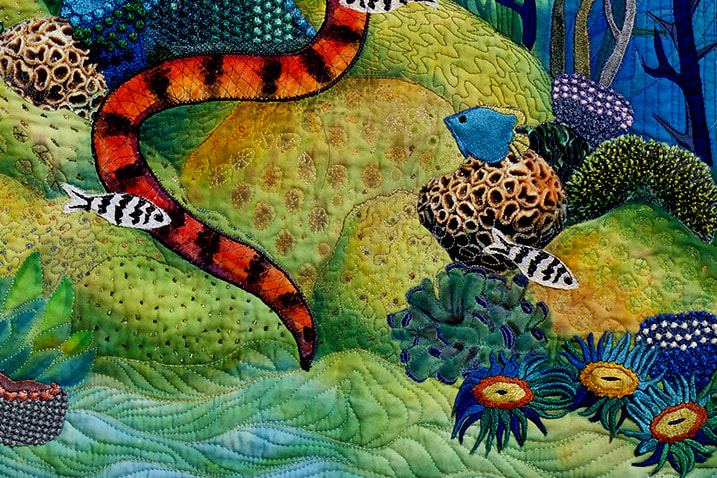
Sea-serpent details
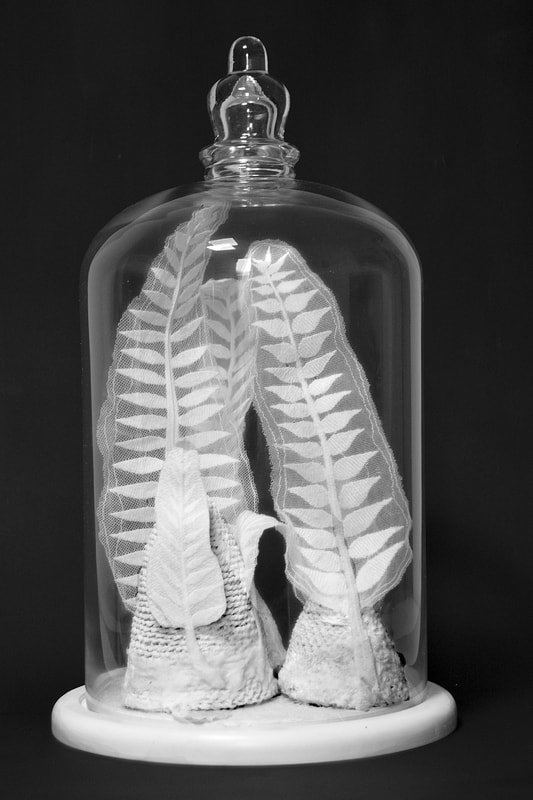
Arboreus.
Arboreus is one of the oldest fossils from the Ediacaran assemblage and here it's rendered in lace. Its fragile fronds sway before a ghostly future landscape. It once ruled the oceans but its fragile structure became buried under mudslides and sand in ancient deltas. These now form today's formidable ramparts of quartzite in Brachina and other gorges.
Winner of Art Quilt Australia, 2015.
Winner of Art Quilt Australia, 2015.
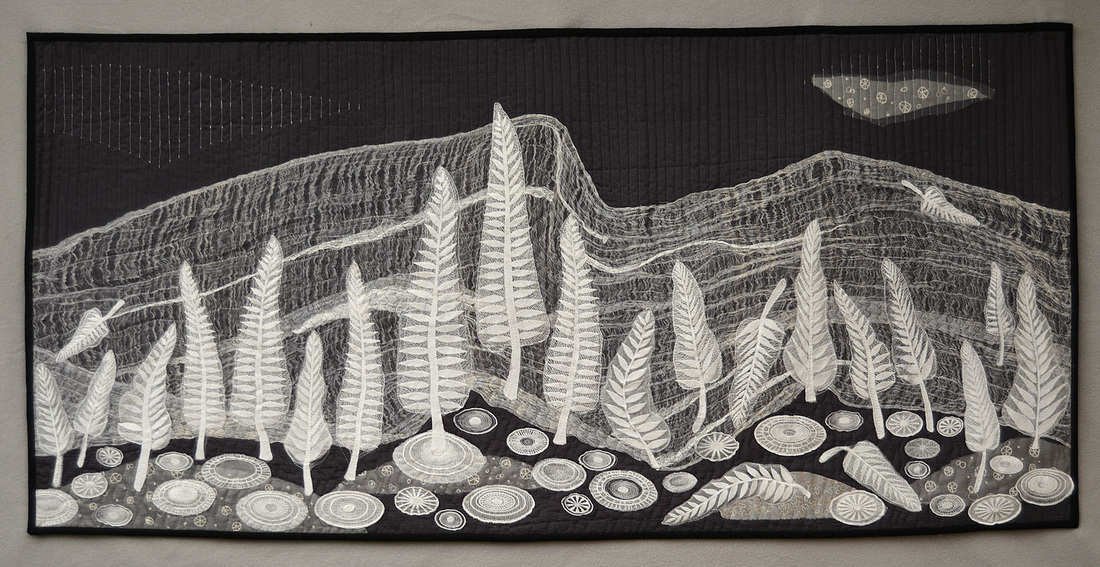
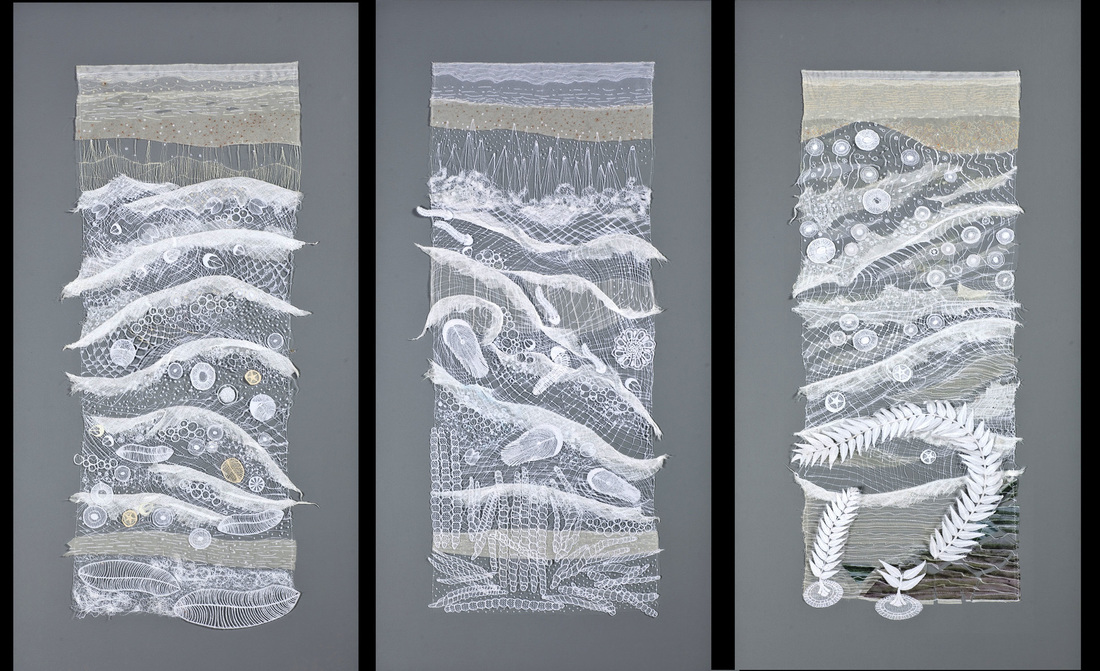
Ediacara: Speculative Assemblages
Ediacara lace panels mounted on canvas, represent communities from that time about 540mya,, as waves washing against a beach. Cotton and nylon net, silk, bandaging gauze, and phot-transfers on organza are used.The set resides in the board room of Beach Energy.
Ediacaran animal imprints are found amid the water-rippled rocks of ancient shallow seas in the Flinders Ranges, treasured examples of first large-life on earth. Imprints represent both cast and mold of individuals: there in their hundreds yet still elusive, revealed only when the light is just right.
Lace at the Art Museum of Denver
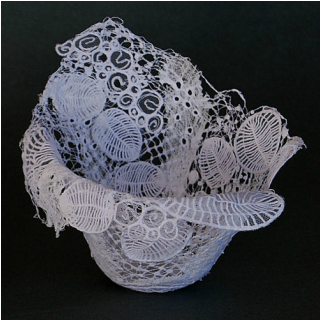
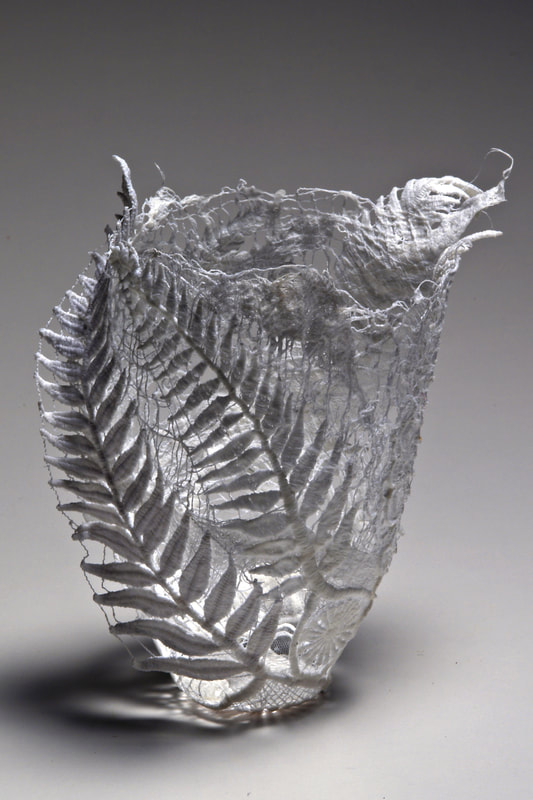
'Dickensonia' lace vessel recently acquired by the Art museum of Denver. Stirched in 100% Swiss cotton thread, with digitally designed motifs of the famous Ediacaran fossil found in the flinders Ranges of south Australa
Vessel is 22cm X 16 cm.
Lace to celebrate the Ediacara fossils
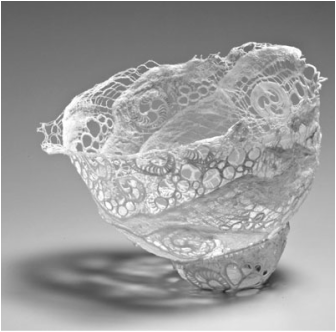
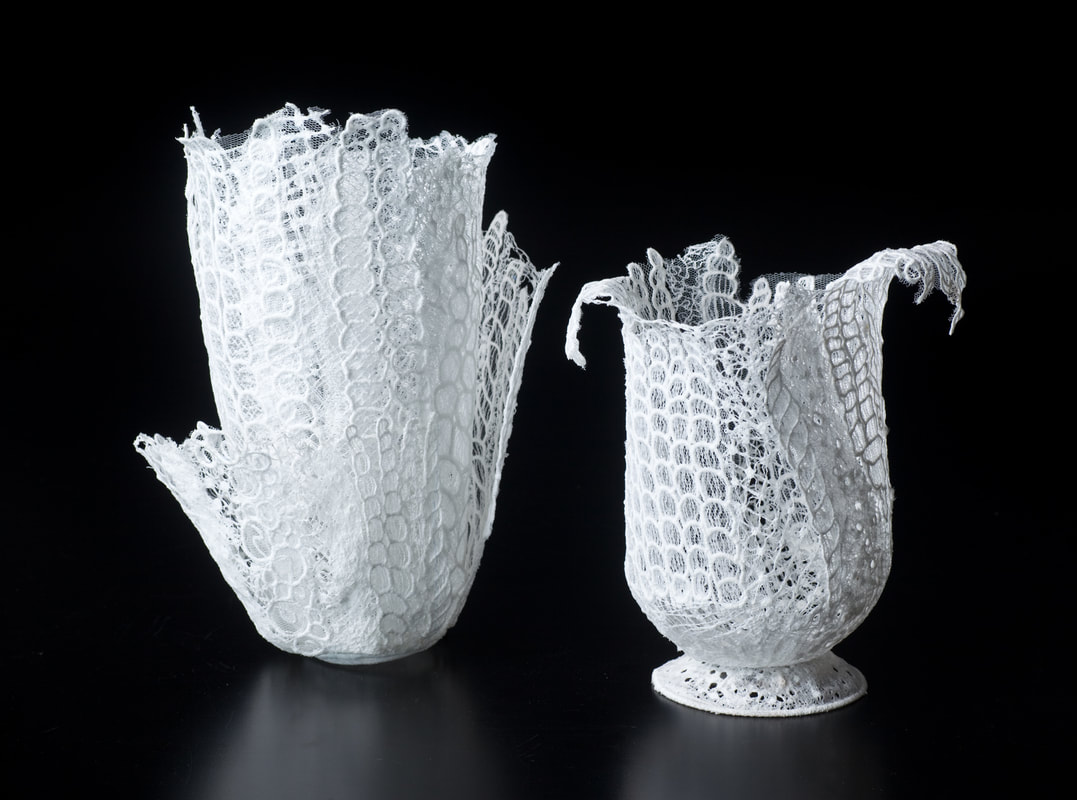
Tribrachidium vessel (approx h22cmxs)
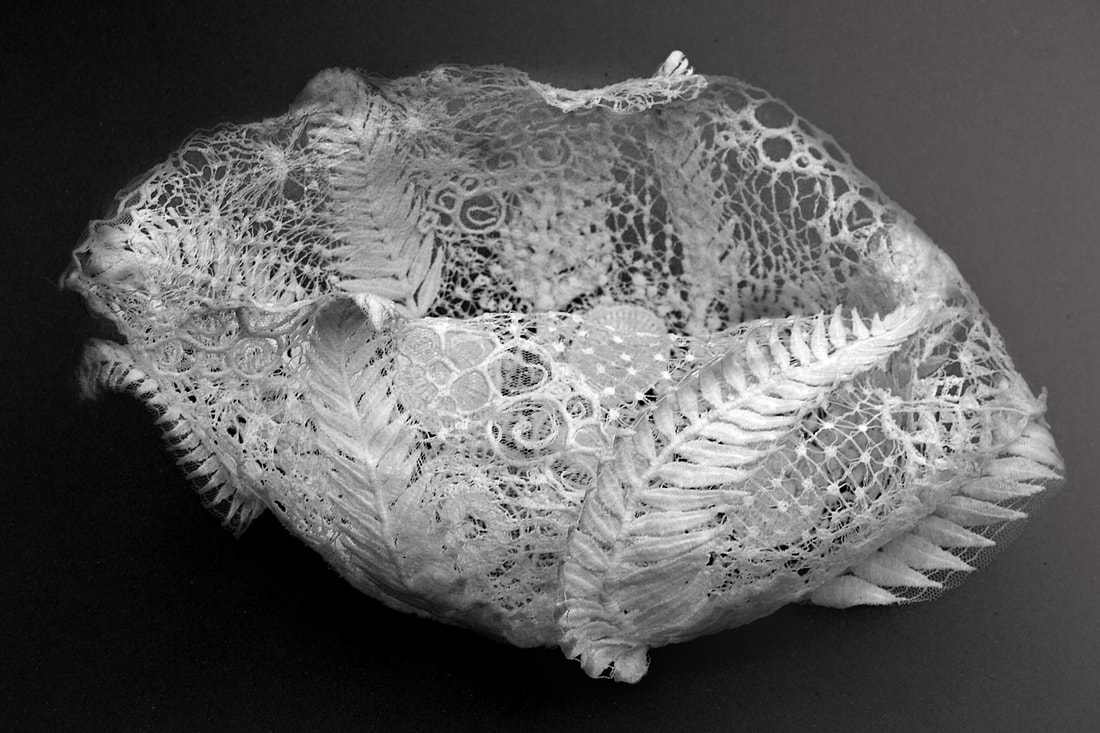
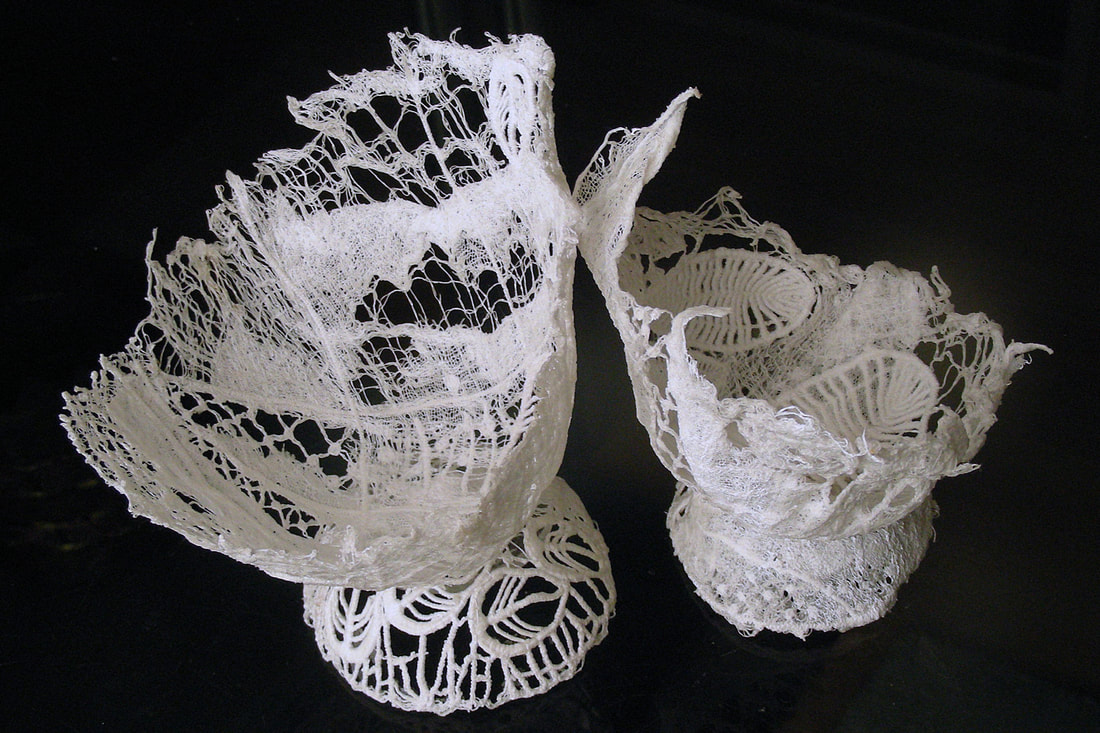
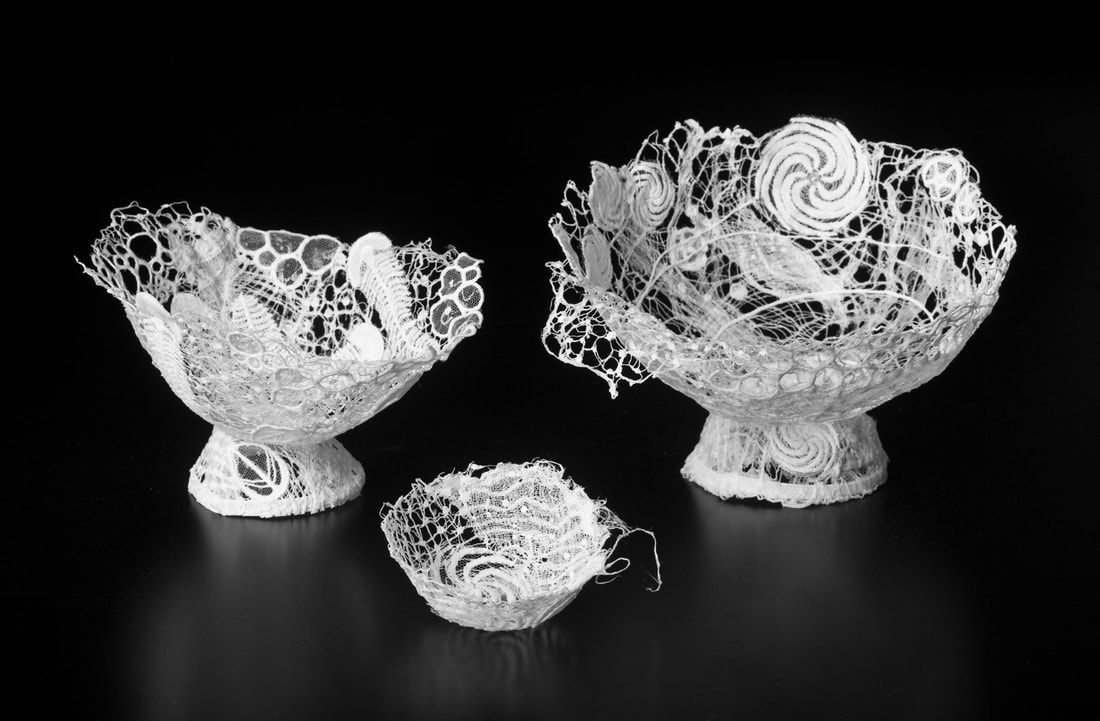
Lace to celebrate the Ediacaran fossils, found in the Flinders Ranges. Elusive in the fine-grained quartzite, many are elegantly fluted enigmas that seem to have no modern counterparts. The Flinders has long been a holiday spot, but the fossil-sites are secret, and for the most part the best items are in the SA Museum Fossil Collection.
The artist decided upon, transparent, lace-like objects to express her wonder at these natural phenomena. Imprints, once discovered are most elusive, and frustratingly vanish under magnification amid the grains of the stone, or as the light changes, or if brittle rock cracks and flakes. Perceptions of form shift from positive to negative depending on the angle of vision and of the light. So it’s the all-white vessels and the shadows they cast that together make up these works. Five are currently in Love Lace exhibition at the Power House Museum, Sydney.
The artist decided upon, transparent, lace-like objects to express her wonder at these natural phenomena. Imprints, once discovered are most elusive, and frustratingly vanish under magnification amid the grains of the stone, or as the light changes, or if brittle rock cracks and flakes. Perceptions of form shift from positive to negative depending on the angle of vision and of the light. So it’s the all-white vessels and the shadows they cast that together make up these works. Five are currently in Love Lace exhibition at the Power House Museum, Sydney.
|
|
|
|
The Water Suite
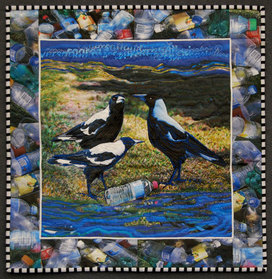
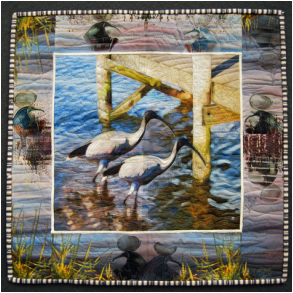
Several small quilts were made from photographs taken on holiday at Goolwa, on the lakes near the mouth of the Murray. Reed beds and dunes, freshwater and salt, the Barrage and invading fur-seals, and stunning ocean surf rolling in from the old southen ocean are all within a few minutes of camp. Magpies squable over anything edible, the ibis fish the shallows and pelicans preen on a favoured sand bar. The imagery is made of composite photographs, transfered and stitched.
|
|
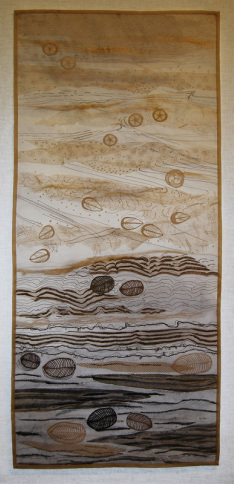
Shades of Ediacara 1
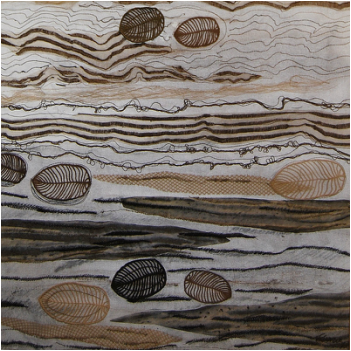
This is the first of a several "Shades" quilts. The technical term for sheers layered and stitched in this way is Shadow Quilting. The Quilt lacks a 'batt' and it is replaced by the materials and motifs that constitute content of the work. The multiple layering thus achieved is stitched together, with other elements added 'on top'. The complex processes allow for great subtlety, an air of fragility and mystery so expressive of the subjects.
|
|
